
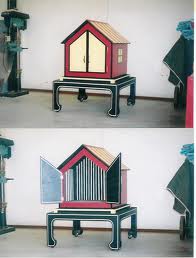
Designer: Frederick Culpitt
The Doll House was invented by Frederick Culpitt in the 1920s and quickly became popular worldwide due to its practicality and deceptiveness.1 It remains popular to this day.
It is an easy way to produce the assistant although sometimes the assistant will produce the magician. Although this trick is called the Dollhouse Illusion, it can be painted to resemble a train engine, bus, school house, car, etc.
A doll house is shown to be empty (often removing the toy furniture in the process of displaying the house). However, when the door is closed, the roof immediately pops open in the center and a full-sized (generally adult) female "doll" - too large to have been hidden within the empty doll house - steps out.
This illusion may sound like a simple effect, but astonishes audiences when done with the great showmanship and flair.
Sources
- Carnegie, Dean. "Fred Culpitt and his Creations," The Magic Detective, July 2012: "The history of the doll house begins in the 1920s when it was first debut by Fred Culpitt." The same post says that "In 1927, the illusion came to America."