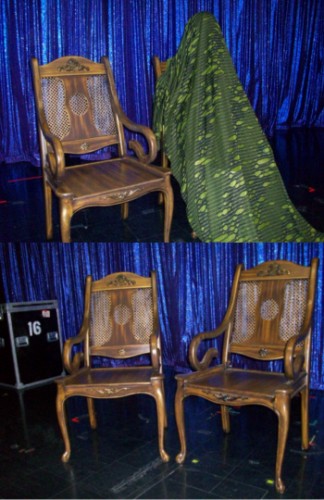
Designer: Buatier DeKolta
The DeKolta Chair (aka "Praying Lady" or "Vanishing Lady") was invented by Buatier DeKolta,1 a French magician who performed primarily during the latter part of the 1800's and up until his sudden death in 1903.2 This particular illusion was first performed in March of 1886. DeKolta used his wife, Alice, as his assistant.
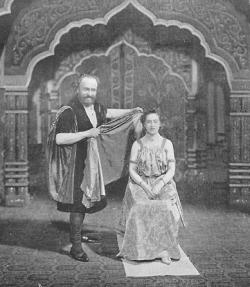
A woman seated (or praying) in a chair would be covered by a large cloth. The magician would then whisk away the cloth causing the woman to instantly vanish. The effect was described by Hoffmann in More Magic (1890).3
In DeKolta's original version, he'd place a newspaper on the floor (showing there was no trap door involved) and a chair on top of it. He would then have his wife sit in the chair and cover her with a cloth. Instantly, the cloth and assistant would vanish. Almost every later version did not do the vanish of the cloth, as it was very difficult and unreliable. In the end, his wife would reappear from the wings.
Sources
- Hopkins, Albert A. Magic: Stage Illusions and Scientific Diversions. Sampson Low, London, 1897. Calls de Kolta one of "the most original and inventive minds in the domain of conjuring" and describes the disappearing-lady chair. Full text at the Internet Archive.
- Evans, Henry Ridgely. The Old and the New Magic. Open Court, Chicago, 1906: "In that city he died of acute Bright's disease on October 7, 1903." Evans also quotes Alexander Herrmann naming "The Vanishing Lady of M. Buatier de Kolta." Full text at the Internet Archive.
- Hoffmann, Professor (Angelo Lewis). More Magic. George Routledge and Sons, London, 1890.